
Last Updated: June 2026

Introduction
The Chevening Scholarship is one of the world’s most prestigious fully funded scholarship programs, offering exceptional professionals and future leaders the opportunity to pursue a one-year master’s degree in the United Kingdom.
Funded by the UK Government through the Foreign, Commonwealth & Development Office (FCDO), Chevening supports outstanding individuals who demonstrate leadership potential, strong professional achievements, and a commitment to creating positive change in their home countries.
Each year, thousands of applicants compete for a limited number of awards, making the scholarship highly competitive. This guide explains everything you need to know about the Chevening Scholarship application process, eligibility requirements, essays, interview preparation, deadlines, and strategies to maximize your chances of success.
Quick Summary
| Category | Details |
|---|---|
| Scholarship Name | Chevening Scholarship |
| Funded By | UK Government (Foreign, Commonwealth & Development Office – FCDO) |
| Study Destination | United Kingdom |
| Degree Level | Master’s Degree (One-Year Program) |
| Scholarship Coverage | Full Tuition Fees, Monthly Stipend, Airfare, Visa Fees, Arrival and Departure Allowances |
| Eligible Applicants | Outstanding Professionals from Chevening-Eligible Countries |
| Work Experience Requirement | Minimum of 2,800 Hours of Professional Experience |
| Number of Course Choices | Three Eligible UK Master’s Courses |
| Key Selection Criteria | Leadership, Networking Skills, Career Vision, Academic Potential, Community Impact |
| Application Process | Online Application → Essays → Shortlisting → Interview → University Offer → Scholarship Award |
| Interview Stage | Conducted by British Embassies or High Commissions |
| Post-Scholarship Requirement | Return to Home Country for at Least Two Years |
| Main Benefits | Fully Funded Study, Global Networking, Leadership Development, Career Advancement |
| Competition Level | Highly Competitive |
| Best Time to Prepare | 6–12 Months Before Applications Open |
| Ideal Candidates | Emerging Leaders, Professionals, Entrepreneurs, Researchers, Public Sector Experts, Development Practitioners |
| Article Covers | Eligibility, Benefits, Essays, Interview Questions, University Selection, Career Opportunities, Success Tips, Official Resources |
Key Takeaway
The Chevening Scholarship is one of the world’s most prestigious fully funded master’s scholarships, offering future leaders the opportunity to study in the United Kingdom while gaining access to a powerful global network. Success depends on demonstrating leadership, professional achievements, networking abilities, and a clear vision for creating positive impact after returning home.
What Is the Chevening Scholarship?
The Chevening Scholarship is a fully funded master’s scholarship that enables talented professionals from eligible countries to study at leading UK universities for one academic year.
Beyond funding, Chevening provides access to a global network of more than 55,000 alumni, including government officials, business leaders, academics, entrepreneurs, diplomats, and innovators.
Scholarship Benefits
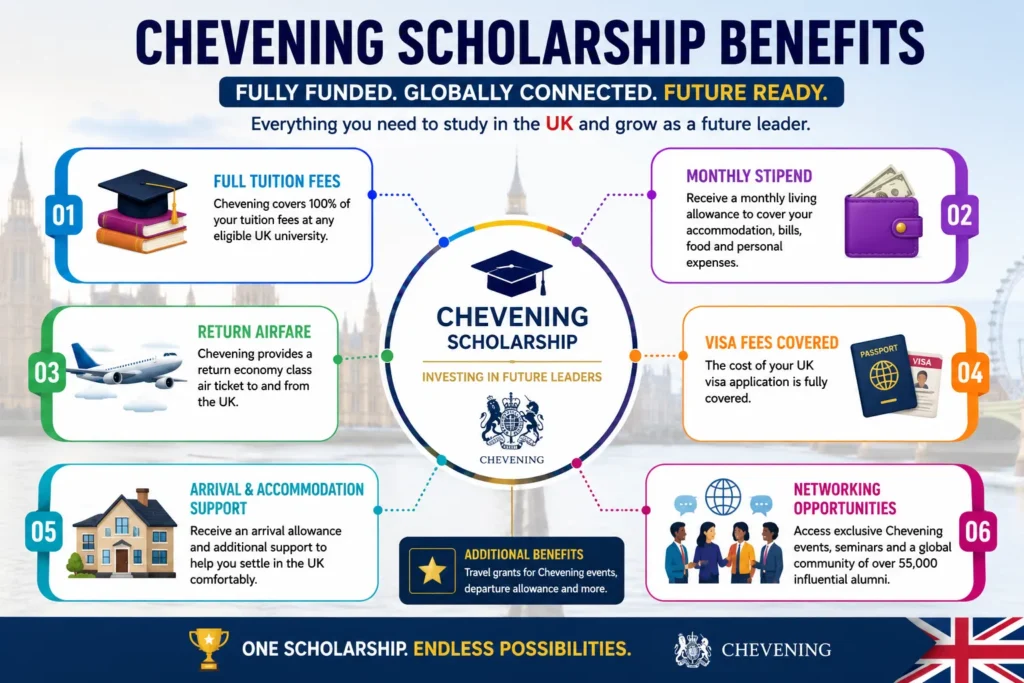
Successful Chevening Scholars receive:
- Full university tuition fees
- Monthly living allowance (stipend)
- Round-trip economy airfare to the UK
- Arrival allowance
- Departure allowance
- UK visa application fees
- Travel grants for official Chevening events
- Access to exclusive networking opportunities
- Membership in the global Chevening alumni network
Chevening Scholarship Eligibility Requirements
To be eligible for a Chevening Scholarship, applicants must:
1. Be a Citizen of an Eligible Country
Applicants must be citizens of a country or territory eligible for the Chevening program.
2. Return Home After Studies
Recipients must commit to returning to their home country for at least two years after completing their studies.
3. Hold an Undergraduate Degree
Applicants must possess a bachelor’s degree that qualifies them for admission to a UK master’s program.
4. Meet the Work Experience Requirement
Applicants must have completed at least 2,800 hours of post-graduation work experience.
Eligible experience may include:
- Full-time employment
- Part-time employment
- Volunteering
- Paid internships
- Unpaid internships
5. Apply to Three Eligible UK Courses
Applicants must select three eligible master’s programs at UK universities and eventually secure at least one unconditional offer.
Why Study in the UK Through Chevening?
The United Kingdom remains one of the world’s most popular study destinations, offering internationally recognized degrees, cutting-edge research opportunities, and access to a diverse global network.
Through the Chevening Scholarship, scholars gain much more than academic qualifications. They become part of a prestigious community of future leaders, policymakers, entrepreneurs, and innovators from over 160 countries.
Benefits of studying in the UK include:
- Access to world-renowned universities
- One-year master’s programs that save time and money
- Exposure to multicultural environments
- Opportunities to engage with global experts
- Enhanced international career prospects
- Membership in the Chevening Alumni Network
For many scholars, the relationships and professional connections built during their studies become as valuable as the degree itself.
Top UK Universities Preferred by Chevening Scholars
Chevening Scholars study at some of the United Kingdom’s most prestigious universities. While the scholarship does not favor any particular institution, many scholars choose universities known for academic excellence, research opportunities, and strong international communities.
Popular destinations include:
- University of Oxford
- University of Cambridge
- London School of Economics and Political Science (LSE)
- Imperial College London
- University College London (UCL)
- University of Edinburgh
- King’s College London
- University of Manchester
- University of Warwick
- University of Bristol
Applicants should select programs based on career goals and academic interests rather than university rankings alone. A well-justified course choice is often more important than attending a globally ranked institution.
Who Is Not Eligible?
You may not qualify if you:
- Hold British citizenship (with limited exceptions)
- Previously received a UK Government-funded scholarship
- Work for certain UK Government-affiliated organizations
- Do not meet the minimum work experience requirement
Chevening Scholarship Selection Criteria
Chevening looks beyond academic excellence.
The program evaluates candidates based on:
Leadership Potential
Applicants should demonstrate examples of leading projects, teams, initiatives, or organizations.
Networking Skills
Candidates must show their ability to build professional relationships and influence others.
Career Vision
Applicants should have a clear plan for how the UK master’s degree will support their long-term goals.
Commitment to Positive Change
Selectors seek individuals capable of creating meaningful impact in their communities, industries, or countries.
How Competitive Is the Chevening Scholarship?
The Chevening Scholarship is among the most competitive international scholarship programs in the world.
Every year, thousands of professionals from more than 160 countries submit applications for a limited number of awards.
Successful applicants typically demonstrate:
- Proven leadership potential
- Strong academic backgrounds
- Significant professional achievements
- Clear career objectives
- A commitment to creating positive change
Competition levels vary by country, but applicants should approach the process with thorough preparation and a long-term strategy.
Step-by-Step Chevening Application Process
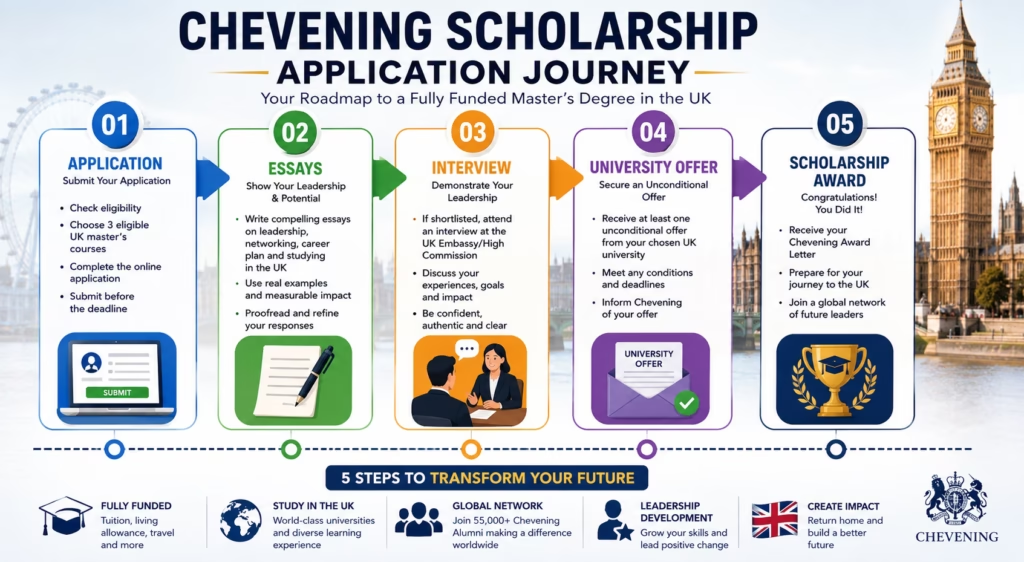
Step 1: Research the Scholarship
Before applying:
- Read all official guidance carefully
- Review eligibility requirements
- Understand the selection criteria
- Study successful scholar profiles
How to Choose the Right UK Master’s Course
Selecting the right course is one of the most important decisions in your Chevening application.
When evaluating programs, consider:
- Career relevance
- Curriculum content
- Research opportunities
- Faculty expertise
- Industry connections
- Graduate employment outcomes
Your chosen courses should support your future goals and demonstrate a logical progression from your professional experience.
Chevening selectors often look for a clear connection between your past achievements, your selected courses, and your long-term vision.
Step 2: Choose Three UK Master’s Courses
Your chosen courses should:
- Align with your career goals
- Strengthen your leadership journey
- Demonstrate a logical academic progression
Avoid selecting courses solely because they are offered by prestigious universities.
The selection committee wants to see a clear connection between your chosen courses and future objectives.
Step 3: Prepare Required Information
Gather:
- Personal information
- Academic history
- Employment records
- Leadership achievements
- Volunteer experience
- Professional accomplishments
Step 4: Write the Application Essays
The essays are the most important part of your application.
Applicants are usually assessed on four major themes:
Leadership and Influence
Demonstrate situations where you led others or drove change.
Networking
Show examples of building meaningful relationships and achieving results through collaboration.
Study in the UK
Explain why your selected courses and universities fit your goals.
Career Plan
Describe your future vision and how Chevening will help you create impact.
Step 5: Submit the Online Application
Complete all sections carefully and submit before the deadline.
Late applications are not accepted.
Step 6: Await Longlisting Results
Applications are reviewed by independent reading committees.
Strong candidates are shortlisted for interviews.
Step 7: Attend the Chevening Interview
Shortlisted applicants attend interviews conducted by British Embassies or High Commissions.
The interview focuses on:
- Leadership experiences
- Networking achievements
- Career objectives
- UK course choices
- Understanding of the Chevening mission
Step 8: Secure an Unconditional University Offer
Successful interview candidates must obtain at least one unconditional offer from a UK university before the specified deadline.
Step 9: Final Selection
Successful applicants receive scholarship offers and begin preparations for their studies in the UK.
Building a Strong Leadership Profile Before Applying
Leadership development should begin long before the application period opens.
If you are planning to apply in future cycles, consider:
- Leading workplace projects
- Organizing community initiatives
- Mentoring students or young professionals
- Volunteering for nonprofit organizations
- Launching entrepreneurial ventures
- Participating in professional associations
These experiences not only strengthen your scholarship application but also contribute to personal and professional growth.
How to Write Winning Chevening Essays
Examples of Leadership Experiences That Impress Chevening Selectors
Many applicants mistakenly believe leadership only means managing a large team. In reality, Chevening values impact and initiative.
Examples of strong leadership experiences include:
- Launching a community project
- Leading a workplace initiative
- Organizing educational programs
- Creating social impact campaigns
- Managing volunteer teams
- Mentoring young professionals
- Starting a business or nonprofit organization
The strongest examples demonstrate measurable outcomes and lasting impact.
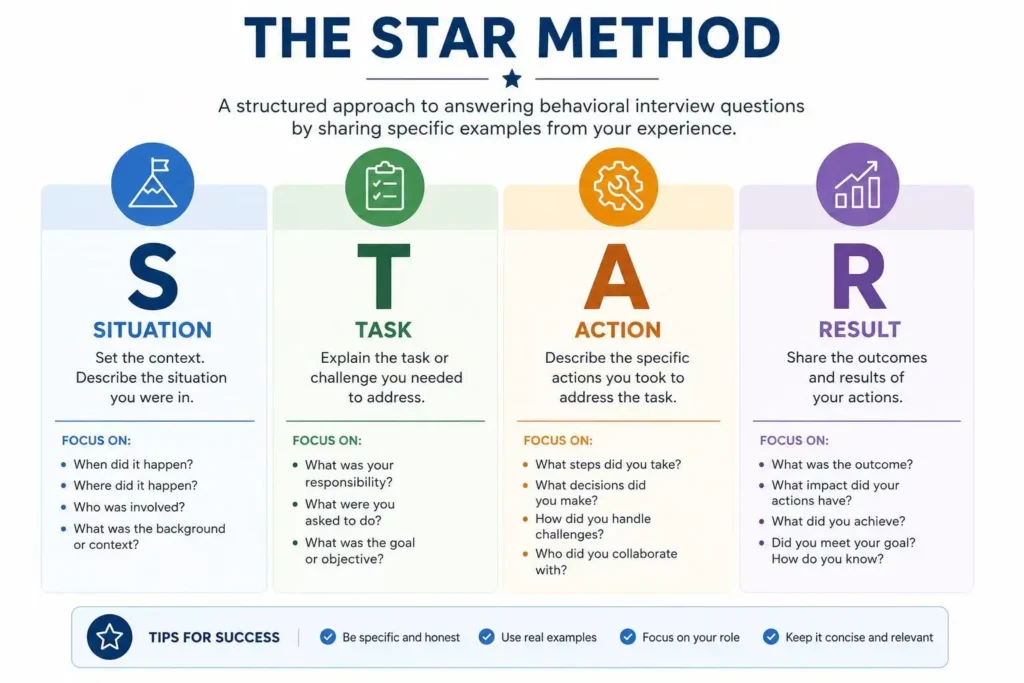
Use the STAR Method
Structure examples using:
- Situation
- Task
- Action
- Result
This method creates compelling and measurable narratives.
Focus on Impact
Instead of listing responsibilities, emphasize results.
Example:
Weak:
“I managed a community project.”
Strong:
“I led a community project that increased school enrollment by 35% within one year.”
Provide Evidence
Support every claim with measurable outcomes.
Numbers and achievements make essays stronger.
Be Authentic
Avoid generic statements.
Use real experiences and personal reflections.
Connect Everything to Your Future Goals
Each essay should reinforce your long-term vision and demonstrate why Chevening is necessary for achieving it.
Common Reasons Applicants Fail
Weak Leadership Examples
Many candidates describe participation rather than leadership.
Generic Career Plans
A vague career vision significantly weakens an application.
Poor Networking Essay
Applicants often underestimate the importance of demonstrating influence through relationships.
Course Choices Without Logic
Selectors want clear connections between:
- Past experience
- Chosen master’s degree
- Future goals
Last-Minute Applications
Rushed applications usually contain weak examples and avoidable mistakes.
Chevening Interview Preparation Tips

Know Your Essays Thoroughly
Interview questions often expand on information provided in your written application.
Practice Leadership Questions
Expect questions such as:
- Tell us about a leadership challenge.
- Describe a difficult decision.
- How have you influenced others?
Understand UK–Home Country Relations
Demonstrate awareness of how your future work can strengthen cooperation and development.
Be Specific
Concrete examples outperform broad statements.
Stay Professional and Confident
The interview assesses both your achievements and your leadership potential.
Common Chevening Interview Questions
While every interview is unique, candidates frequently encounter questions such as:
Leadership
- Tell us about a leadership challenge you faced.
- How have you influenced others?
- Describe a project you are most proud of.
Career Goals
- Where do you see yourself in five years?
- How will your UK degree contribute to your career?
Study Plans
- Why did you choose your selected courses?
- Why did you choose the UK?
Chevening
- Why do you deserve a Chevening Scholarship?
- What does leadership mean to you?
- How will you contribute to the Chevening network?
Preparing thoughtful and authentic responses can significantly improve interview performance.
Chevening Scholarship Timeline Explained
Understanding the scholarship timeline helps applicants prepare effectively and avoid missing important deadlines.
The typical process includes:
August–November
Application period opens and closes.
November–February
Applications undergo independent review.
February–April
Shortlisted candidates receive interview invitations.
March–May
Interviews are conducted by British Embassies and High Commissions.
June–July
Conditional scholarship offers are issued.
July
Applicants submit final university offers and required documents.
September–October
Successful scholars travel to the United Kingdom and begin their studies.
Recommended Application Timeline
12 Months Before Deadline
- Research Chevening
- Build leadership experiences
- Improve your professional profile
6 Months Before Deadline
- Research UK universities
- Select potential courses
- Draft career goals
3 Months Before Deadline
- Write essay drafts
- Seek feedback
- Refine examples
1 Month Before Deadline
- Complete application
- Proofread thoroughly
- Verify all information
Before Submission
- Review every section carefully
- Ensure consistency across essays
- Submit early
Most Common Chevening Interview Questions and Sample Answers
Introduction
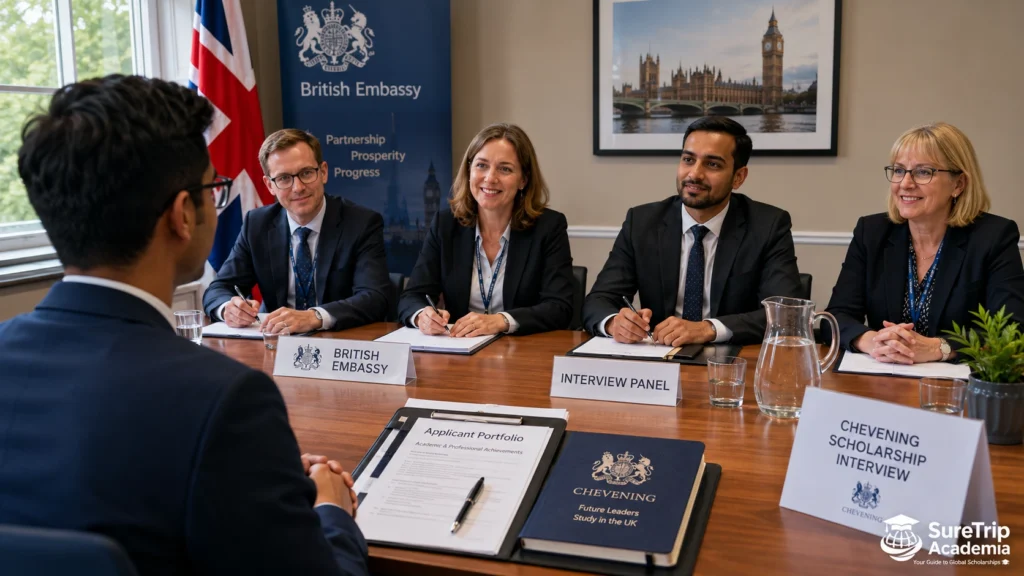
The Chevening interview is the final and most important stage of the scholarship selection process. At this stage, the interview panel already believes you are a strong candidate based on your written application.
The interview is designed to assess your leadership potential, career ambitions, networking abilities, and commitment to creating positive impact in your home country.
While there is no guaranteed set of questions, many candidates report facing similar themes during their interviews. Preparing for these questions can significantly improve your confidence and performance.
Leadership Questions
1. Tell Us About Yourself
What the Panel Wants to Assess
- Communication skills
- Professional background
- Career progression
- Leadership potential
Sample Answer
“I am a public health professional with six years of experience managing community healthcare projects. Throughout my career, I have focused on improving access to healthcare services in underserved communities. I currently coordinate health outreach programs that serve more than 20,000 residents annually. My long-term goal is to influence national healthcare policy, and I believe a master’s degree in Public Health from the UK will equip me with the skills and global perspective needed to achieve that objective.”
2. Describe a Leadership Challenge You Faced
What the Panel Wants to Assess
- Leadership ability
- Problem-solving skills
- Decision-making
Sample Answer
“While managing a community education project, we experienced a significant funding shortfall that threatened implementation. I assembled stakeholders, developed a revised budget, secured local partnerships, and mobilized volunteers. As a result, we completed the project successfully and reached over 5,000 beneficiaries despite the reduced budget.”
3. What Is Your Greatest Leadership Achievement?
Sample Answer
“One of my proudest achievements was leading a digital literacy initiative for rural youth. I coordinated a team of volunteers, partnered with local schools, and secured private sponsorship. Within one year, the project trained over 1,200 students and improved digital skills access across several communities.”
4. How Have You Influenced Others?
Sample Answer
“In my workplace, I noticed inefficiencies in project reporting. I introduced a new reporting framework and organized training sessions for staff. The approach improved reporting accuracy and reduced submission delays by more than 40 percent. The framework was later adopted across multiple departments.”
Networking Questions
5. What Does Networking Mean to You?
Sample Answer
“Networking is the process of building mutually beneficial professional relationships based on trust, collaboration, and shared goals. Effective networking creates opportunities for learning, partnership development, and collective problem-solving.”
6. Give an Example of Successful Networking
Sample Answer
“To launch a youth entrepreneurship program, I connected local business leaders, government agencies, and nonprofit organizations. These partnerships provided mentorship, funding, and training opportunities that helped more than 200 young entrepreneurs start small businesses.”
7. How Will You Contribute to the Chevening Network?
Sample Answer
“I intend to actively participate in Chevening events, collaborate with scholars from diverse sectors, and share expertise from my professional field. I also hope to establish partnerships that can support development initiatives in my home country.”
Studying in the UK Questions
8. Why Do You Want to Study in the UK?
Sample Answer
“The UK offers globally recognized academic programs, world-class research facilities, and exposure to diverse perspectives. Studying in the UK will allow me to learn from leading experts while building international networks that support my long-term professional goals.”
9. Why Did You Choose These Courses?
Sample Answer
“My selected courses align directly with my professional experience and future ambitions. Each program offers specialized modules that address policy development, leadership, and strategic management, which are essential for my planned career progression.”
10. Why Did You Select These Universities?
Sample Answer
“I selected these universities because of their strong academic reputation, relevant curriculum, distinguished faculty, and research strengths in my area of interest. They provide the ideal environment for achieving my academic and professional objectives.”
Career Goals Questions
11. What Are Your Career Goals?
Sample Answer
“In the short term, I aim to return to my organization and apply advanced knowledge gained in the UK. In the long term, I plan to contribute to national policy development and lead initiatives that improve public service delivery within my country.”
12. Where Do You See Yourself in Five Years?
Sample Answer
“In five years, I envision myself holding a senior leadership role within my sector, leading strategic projects, influencing policy decisions, and mentoring emerging professionals.”
13. How Will Chevening Help You Achieve Your Goals?
Sample Answer
“Chevening will provide access to world-class education, global networks, leadership development opportunities, and exposure to innovative practices. These experiences will strengthen my ability to create meaningful impact upon returning home.”
Impact and Development Questions
14. What Problem in Your Country Would You Like to Solve?
Sample Answer
“One challenge I am passionate about addressing is youth unemployment. Through policy innovation, skills development programs, and public-private partnerships, I hope to contribute to sustainable employment opportunities for young people.”
15. How Will You Create Change After Returning Home?
Sample Answer
“Upon returning, I intend to implement evidence-based solutions, strengthen institutional capacity, and collaborate with key stakeholders to address development challenges within my sector.”
Personal Questions
16. Why Should We Select You?
Sample Answer
“I possess a strong combination of leadership experience, professional achievements, community engagement, and a clear vision for future impact. I am committed to applying the knowledge and networks gained through Chevening to create meaningful change in my country.”
17. What Are Your Strengths?
Sample Answer
“My strengths include strategic thinking, leadership, collaboration, adaptability, and effective communication. These qualities have helped me successfully manage projects and build productive partnerships.”
18. What Is Your Biggest Weakness?
Sample Answer
“Earlier in my career, I found it difficult to delegate responsibilities because I wanted to ensure high-quality outcomes. Over time, I learned the importance of empowering team members and trusting others to contribute effectively.”
Questions You Can Ask the Interview Panel
At the end of the interview, you may be invited to ask questions.
Examples include:
- What qualities distinguish the most successful Chevening Scholars?
- How can scholars maximize opportunities within the Chevening network?
- What leadership activities are available during the scholarship year?
Avoid questions that can easily be answered through the official website.
Final Interview Tips
Review Your Essays Thoroughly
Every answer should align with information provided in your application.
Use Real Examples
Provide specific situations and measurable outcomes.
Apply the STAR Method
Structure responses using:
- Situation
- Task
- Action
- Result
Stay Authentic
The panel wants to understand your genuine experiences and aspirations.
Demonstrate Impact
Show how your leadership has produced measurable results.
Remain Calm and Professional
Confidence, clarity, and authenticity often distinguish successful candidates.
Final Thoughts
The Chevening interview is not designed to trick applicants. It is an opportunity to demonstrate the leadership potential, professional achievements, and vision that were highlighted in your written application.
Strong candidates present clear career goals, compelling leadership stories, meaningful networking experiences, and a realistic plan for creating positive change after returning home.
Preparation, self-awareness, and confidence can greatly improve your chances of joining the global Chevening community and becoming a future leader supported by one of the world’s most prestigious scholarship programs.

Chevening Scholarship Success Tips
Start Early
Strong applications are built over months, not days.
Focus on Leadership
Leadership is often the most important factor in selection.
Demonstrate Impact
Show measurable results wherever possible.
Build a Strong Professional Profile
Volunteer work, community engagement, and professional achievements strengthen applications.
Be Strategic With Course Selection
Choose programs that clearly support your career objectives.
Life as a Chevening Scholar in the UK
Being a Chevening Scholar extends beyond the classroom.
Scholars participate in:
- Academic conferences
- Leadership workshops
- Cultural exchange events
- Networking sessions
- Government-sponsored activities
- Professional development programs
These experiences provide valuable opportunities to connect with future leaders from around the world while gaining insights into British society, culture, and governance.
Chevening Success Stories
Thousands of Chevening alumni have gone on to become:
- Government ministers
- Diplomats
- CEOs
- Entrepreneurs
- Researchers
- University professors
- International development leaders
Their success demonstrates the transformative impact of the scholarship and highlights the opportunities available to future scholars.
Applicants should study alumni stories to better understand the qualities Chevening seeks in successful candidates.
Career Opportunities After Completing a Chevening Scholarship
Chevening alumni often return to their countries with enhanced skills, international networks, and new perspectives.
Graduates frequently pursue careers in:
- Government and public policy
- International development
- Diplomacy
- Business leadership
- Entrepreneurship
- Education and research
- Non-governmental organizations
The scholarship’s global reputation can significantly strengthen career prospects and professional credibility.
Frequently Asked Questions
Is Chevening Fully Funded?
Yes. The scholarship covers tuition fees, living expenses, travel costs, and additional allowances.
Can Fresh Graduates Apply?
Generally, applicants need the required post-graduation work experience, making immediate applications after graduation difficult.
Do I Need IELTS?
Chevening itself does not currently require an English language test, but universities may have their own requirements.
Can I Apply With a Master’s Degree Already?
Yes. Having a master’s degree does not automatically disqualify you.
How Competitive Is Chevening?
Extremely competitive. Thousands of professionals apply worldwide each year.
Chevening Scholarship Application Checklist
Before submitting your application, ensure you have:
✓ Verified eligibility requirements
✓ Selected three eligible UK master’s courses
✓ Recorded all qualifying work experience
✓ Prepared leadership examples
✓ Written networking essay
✓ Completed study-in-the-UK essay
✓ Completed career goals essay
✓ Proofread all application responses
✓ Reviewed application details for consistency
✓ Submitted before the official deadline
Using this checklist can help reduce errors and improve application quality.

Official Resources and Useful Links
The following resources can help you throughout your application journey:
Official Chevening Resources
| Resource | Link |
|---|---|
| Chevening Scholarship Official Website | https://www.chevening.org/ |
| Eligibility Requirements | https://www.chevening.org/scholarships/who-can-apply/eligibility/ |
| Application Guidance | https://www.chevening.org/scholarships/guidance/ |
| Frequently Asked Questions | https://www.chevening.org/faqs/ |
| Alumni Stories | https://www.chevening.org/alumni/ |
UK Study Resources
| Resource | Link |
|---|---|
| Study UK | https://study-uk.britishcouncil.org/ |
| UK University Course Search | https://www.ucas.com/explore/search/all |
| Student Visa Information | https://www.gov.uk/student-visa |
Always verify information through official sources before making application decisions.
Final Thoughts
The Chevening Scholarship is more than financial support for a master’s degree. It is an investment in future leaders who can drive meaningful change in their countries and beyond.
A successful application requires clear leadership evidence, strong networking examples, realistic career goals, and a compelling explanation of how studying in the UK will help you achieve your ambitions.
If you start early, craft thoughtful essays, and demonstrate measurable impact, you can significantly improve your chances of becoming a Chevening Scholar and joining one of the world’s most influential global leadership networks.
About the Author
SureTripAcademia provides practical guidance on:
- Study abroad opportunities
- Scholarships
- International admissions
- Student visas
- Global career opportunities
- Relocation planning
Our mission is to help students and professionals make informed decisions about international education and migration opportunities.
For inquiries:
- Website: SureTripAcademia
- Email: admin@suretripacademia.com
- WhatsApp: +8615008083706
- Facebook: SureTripAcademia
- TikTok: SureTripAcademia
Related Articles
- Scholarships That Cover Tuition, Accommodation and Flights
- Healthcare Jobs in Europe and Western Countries
- Construction Jobs Abroad
- Countries with Higher Visa Approval Rates
- Cheapest Universities in Europe
- University of Tokyo MEXT Scholarship
- Study in Iceland for Free