
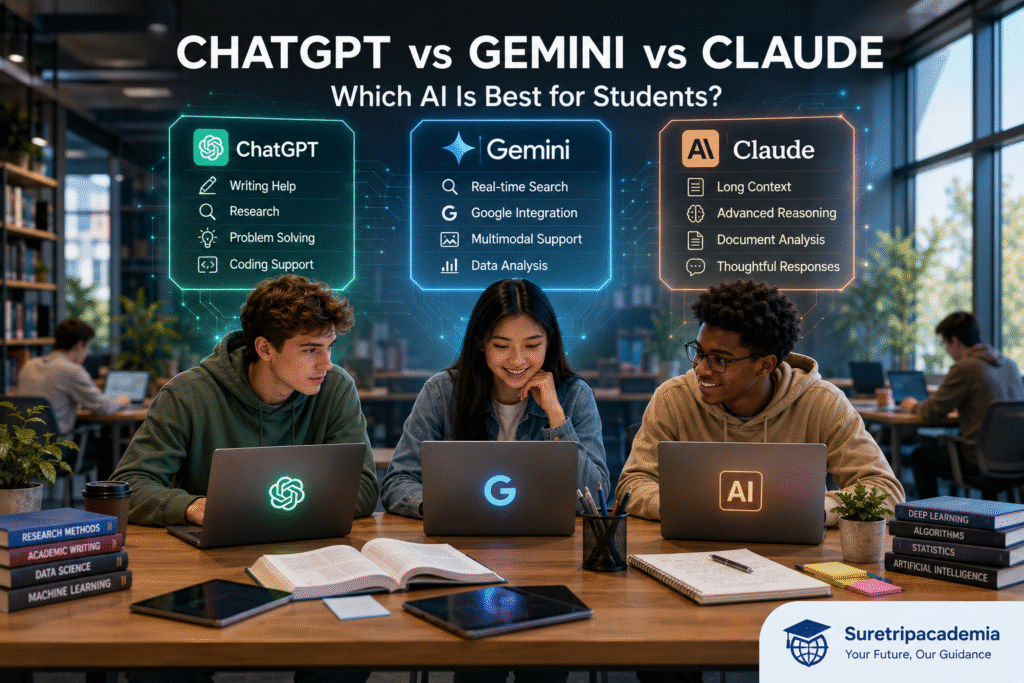
Artificial Intelligence has rapidly become one of the most valuable academic tools available to students. From summarizing research papers and generating study notes to solving complex problems and preparing scholarship applications, AI assistants are transforming how students learn, study, and succeed.
Among the most popular AI platforms available today are:
- ChatGPT
- Gemini
- Claude
Each platform offers unique strengths, capabilities, and limitations.
The question many students are asking is simple:
Which AI assistant is actually best for studying, research, assignments, productivity, and academic success?
This comprehensive guide compares ChatGPT, Gemini, and Claude across every category that matters to students.
What Are AI Study Assistants?
AI study assistants are advanced language models capable of understanding and generating human-like text.
Students use them to:
- Explain difficult concepts
- Create study guides
- Summarize textbooks
- Generate practice questions
- Improve writing
- Analyze research papers
- Learn programming
- Organize coursework
When used responsibly, AI can become a powerful educational companion.
Why Students Are Using AI More Than Ever
Modern students face increasing academic demands.
They must balance:
- Assignments
- Research projects
- Exams
- Scholarship applications
- Part-time jobs
- Extracurricular activities
AI tools help reduce repetitive work while allowing students to focus on deeper learning and critical thinking.
Overview of ChatGPT
ChatGPT, developed by OpenAI, has become the most widely used AI assistant globally.
Strengths
- Excellent conversational abilities
- Strong writing assistance
- High-quality tutoring
- Coding support
- Research assistance
- Creative content generation
Ideal For
- Students
- Researchers
- Writers
- Programmers
- Scholarship applicants
Overview of Gemini
Gemini, developed by Google, is deeply integrated into Google’s ecosystem.
Strengths
- Strong web connectivity
- Access to Google services
- Research assistance
- Productivity integration
Ideal For
- Students already using Google Workspace
- Researchers seeking web-connected information
- Collaborative academic work
Overview of Claude
Claude, developed by Anthropic, has gained popularity for its thoughtful responses and long-context processing.
Strengths
- Long document analysis
- Research support
- Natural writing style
- Strong reasoning
Ideal For
- Academic researchers
- Graduate students
- Long-form writing projects
Research Capabilities Comparison
| Feature | ChatGPT | Gemini | Claude |
|---|---|---|---|
| Research Support | Excellent | Excellent | Excellent |
| Document Analysis | Excellent | Very Good | Excellent |
| Academic Explanation | Excellent | Good | Excellent |
| Source Understanding | Excellent | Good | Excellent |
Winner
ChatGPT and Claude
Both consistently provide deeper explanations and stronger reasoning.
Essay Writing Comparison
Students frequently use AI for:
- Outlining essays
- Improving grammar
- Brainstorming ideas
- Structuring arguments
| Tool | Rating |
|---|---|
| ChatGPT | 9.5/10 |
| Claude | 9.3/10 |
| Gemini | 8.5/10 |
Winner
ChatGPT
Its ability to adapt tone, structure, and academic style makes it particularly useful for student writing.
Scholarship Applications and Personal Statements
Scholarship essays require:
- Authentic storytelling
- Strong structure
- Clear objectives
Best Tool
ChatGPT
ChatGPT excels at:
- Scholarship essays
- Motivation letters
- Personal statements
- Application editing
Claude performs well but tends to produce more formal and cautious responses.
Thesis and Dissertation Support
Graduate students often need assistance with:
- Literature reviews
- Research synthesis
- Academic writing
Best Tool
Claude
Claude’s long-context capabilities make it particularly useful for handling large academic documents.
Coding and Programming
| Category | ChatGPT | Gemini | Claude |
|---|---|---|---|
| Python | Excellent | Very Good | Excellent |
| JavaScript | Excellent | Good | Very Good |
| Debugging | Excellent | Good | Very Good |
| Explanations | Excellent | Good | Excellent |
Winner
ChatGPT
Programming students generally benefit most from ChatGPT’s detailed explanations and debugging support.
Mathematics Assistance
ChatGPT
- Excellent explanations
- Step-by-step solutions
- Concept understanding
Gemini
- Strong computational support
Claude
- Strong reasoning
Winner
ChatGPT
Students consistently find ChatGPT easier to follow when learning complex mathematical concepts.
File Upload and PDF Analysis
Students often need help analyzing:
- Lecture notes
- PDFs
- Research papers
- Textbooks
Rankings
- Claude
- ChatGPT
- Gemini
Claude’s ability to process extensive documents remains one of its biggest advantages.
Long Context Window Comparison
| AI Tool | Long Document Handling |
|---|---|
| Claude | Outstanding |
| ChatGPT | Excellent |
| Gemini | Very Good |
Winner
Claude
Researchers working with large documents will appreciate Claude’s capacity.
Creativity Comparison
Students also use AI for:
- Presentations
- Projects
- Brainstorming
- Content creation
| Tool | Creativity Score |
|---|---|
| ChatGPT | 10/10 |
| Claude | 9/10 |
| Gemini | 8/10 |
Winner
ChatGPT
Best AI for Different Types of Students

High School Students
Best Choice: ChatGPT
Why?
- Easy explanations
- Interactive learning
- Homework support
- Study planning
University Students
Best Choice: ChatGPT
Offers the best balance between:
- Research
- Writing
- Learning
- Productivity
Master’s and PhD Students
Best Choice: Claude
Particularly valuable for:
- Research papers
- Thesis work
- Long document analysis
Scholarship Applicants
Best Choice: ChatGPT
Excellent for:
- Personal statements
- Motivation letters
- Scholarship essays
Pricing Comparison
| Feature | ChatGPT | Gemini | Claude |
|---|---|---|---|
| Free Version | Yes | Yes | Yes |
| Premium Plan | Available | Available | Available |
| Student Value | Excellent | Good | Excellent |
For most students, free versions are sufficient for everyday academic tasks.
Privacy and Ethical Considerations
Students should remember:
- Never submit AI-generated work without reviewing it.
- Verify factual claims.
- Follow institutional policies.
- Avoid sharing sensitive personal information.
AI should support learning, not replace it.
AI Tools by Academic Task
| Task | Best Tool |
|---|---|
| Essay Writing | ChatGPT |
| Coding | ChatGPT |
| Research Papers | Claude |
| Scholarship Applications | ChatGPT |
| Thesis Support | Claude |
| Brainstorming | ChatGPT |
| Google Integration | Gemini |
| Long Documents | Claude |
| Tutoring | ChatGPT |
| Productivity | Gemini |
Future of AI in Education

AI will increasingly become a standard educational tool.
Future developments are expected to include:
- Personalized tutors
- Real-time learning assistance
- Adaptive study plans
- Research automation
- Intelligent feedback systems
Students who learn to use AI responsibly today will gain significant advantages tomorrow.
Choose ChatGPT If:
- You want the best all-around student assistant.
- You need help with writing, studying, coding, and scholarship applications.
- You want the most versatile AI platform.
Choose Claude If:
- You work with large documents.
- You conduct extensive research.
- You are a graduate student or researcher.
Choose Gemini If:
- You rely heavily on Google Workspace.
- You want seamless integration with Google’s ecosystem.
Overall Winner for Students
🥇 ChatGPT
Best Research Assistant
🥇 Claude
Best Google Ecosystem Integration
🥇 Gemini
The best AI tool ultimately depends on your academic goals, learning style, and daily workflow.
However, for the majority of students seeking a single AI assistant that can help with studying, writing, research, productivity, and career preparation, ChatGPT remains the most balanced and versatile option available today.
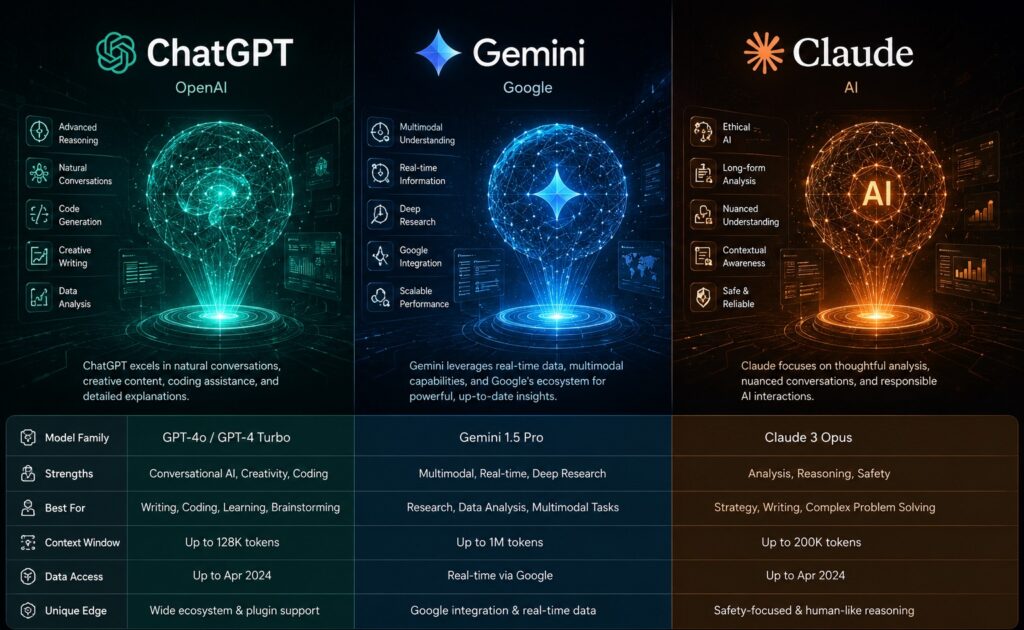
AI in Education by the Numbers
Artificial Intelligence is no longer a futuristic concept in education—it is already reshaping how students learn, research, and prepare for their careers.
The rapid adoption of AI-powered tools across schools, colleges, and universities demonstrates that digital learning assistants are becoming a standard component of modern education.
Key Statistics Every Student Should Know
- Millions of students worldwide now use AI-powered learning tools regularly.
- Universities are increasingly integrating AI literacy into their curricula.
- AI-assisted tutoring platforms continue experiencing significant growth.
- Employers increasingly expect graduates to understand how to work effectively with AI systems.
- Research institutions are investing heavily in AI-powered discovery and innovation.
What These Trends Mean
Students who develop AI literacy today are positioning themselves for success in a future workforce where human-AI collaboration becomes a normal part of professional life.
The question is no longer whether students should learn to use AI. The question is how effectively they can use it to improve learning, productivity, and career readiness.
How Students Should Use AI Ethically
Artificial Intelligence is a powerful educational tool, but its value depends on how it is used.
Responsible AI use can enhance learning, improve productivity, and strengthen understanding. Misuse can undermine academic integrity and limit genuine skill development.
Ethical Ways to Use AI
Brainstorming Ideas
Students can use AI to generate ideas for essays, projects, presentations, and research topics.
Explaining Difficult Concepts
AI can simplify complex subjects and provide alternative explanations that improve understanding.
Editing and Proofreading
Students can improve clarity, grammar, structure, and readability while maintaining ownership of their work.
Creating Study Materials
AI can help generate flashcards, quizzes, summaries, and practice questions.
Research Support
Students can use AI to organize information, summarize findings, and identify areas for further exploration.
Unethical Uses of AI
- Submitting AI-generated work as original work.
- Using AI to complete examinations without authorization.
- Fabricating sources or citations.
- Bypassing learning objectives.
The Golden Rule
Use AI as a tutor, assistant, and collaborator—not as a substitute for learning.
Can AI Help Students Get Better Grades?

The answer depends less on the AI tool itself and more on how it is used.
Students who leverage AI strategically often improve their academic performance because they:
- Study more efficiently.
- Understand difficult concepts faster.
- Receive immediate feedback.
- Generate practice materials.
- Organize information effectively.
However, students who rely on AI without understanding the material may experience short-term gains but long-term learning deficiencies.
The Most Effective Approach
Use AI to:
- Learn concepts.
- Test understanding.
- Identify weaknesses.
- Practice repeatedly.
- Improve communication skills.
The combination of AI assistance and active learning creates the strongest academic outcomes.
Best AI Tool by Degree Program
Different academic disciplines benefit from different AI strengths.
| Degree Program | Recommended AI |
|---|---|
| Computer Science | ChatGPT |
| Software Engineering | ChatGPT |
| Artificial Intelligence | ChatGPT |
| Data Science | ChatGPT |
| Cybersecurity | ChatGPT |
| Medicine | Claude |
| Nursing | Claude |
| Pharmacy | Claude |
| Biotechnology | Claude |
| Law | Claude |
| Business Administration | ChatGPT |
| International Business | ChatGPT |
| Finance | ChatGPT |
| Economics | Claude |
| Literature | Claude |
| Journalism | ChatGPT |
| Education | ChatGPT |
| Engineering | ChatGPT |
| Research-Based Master’s Programs | Claude |
| PhD Programs | Claude |
Why the Difference?
ChatGPT excels in versatility, tutoring, coding, brainstorming, and student productivity.
Claude excels in long-form analysis, research synthesis, and processing large academic documents.
Gemini remains particularly useful for students deeply integrated into Google’s ecosystem.
Best AI Tool by Personality Type
Students often learn differently.
Choosing an AI assistant that complements your learning style can improve effectiveness.
| Personality Type | Recommended AI |
|---|---|
| Curious Explorer | ChatGPT |
| Deep Researcher | Claude |
| Analytical Thinker | Claude |
| Creative Thinker | ChatGPT |
| Entrepreneurial Student | ChatGPT |
| Structured Learner | Claude |
| Visual Learner | Gemini |
| Productivity-Focused Student | Gemini |
| Independent Learner | ChatGPT |
| Graduate Researcher | Claude |
Key Insight
There is no universally perfect AI assistant.
The best tool depends on how you learn, think, and work.
How Professors View AI in 2026
The relationship between higher education and AI continues evolving.
Many educators now recognize that AI is becoming an unavoidable component of modern academic and professional life.
Rather than banning AI entirely, institutions increasingly focus on teaching students how to use it responsibly.
What Professors Generally Support
- Research assistance
- Concept explanations
- Study planning
- Proofreading
- Brainstorming
What Professors Generally Oppose
- Academic dishonesty
- Unattributed AI-generated submissions
- Fabricated citations
- Bypassing learning objectives
The future of education is likely to emphasize AI literacy alongside traditional academic skills.
AI-Powered Study Workflow
Students often ask how they should actually use AI throughout the learning process.
The following workflow can dramatically improve efficiency.
Step 1: Learn the Concept
Use ChatGPT or Claude to explain difficult topics.
Step 2: Create Notes
Generate concise summaries and key points.
Step 3: Generate Practice Questions
Create quizzes and flashcards based on lecture content.
Step 4: Test Understanding
Ask the AI to challenge your knowledge.
Step 5: Fill Knowledge Gaps
Review areas where you struggle.
Step 6: Prepare for Exams
Create revision guides and mock examinations.
Step 7: Review and Reflect
Use AI feedback to improve future performance.
This process transforms AI from a simple chatbot into a comprehensive learning assistant.
Will AI Replace Traditional Learning?
Some students fear that AI may eventually replace traditional education.
This is unlikely.
Education is not simply about obtaining information.
It also involves:
- Critical thinking
- Communication
- Leadership
- Collaboration
- Creativity
- Character development
AI can deliver information efficiently, but it cannot fully replace the human experiences that shape personal and professional growth.
The future is more likely to involve AI-enhanced learning rather than AI-replaced learning.
Future of AI in Universities (2030–2040)

The next decade may bring profound changes to higher education.
Expected Developments
Personalized Learning
AI tutors may adapt instruction to each student’s learning style and pace.
Intelligent Research Assistants
Students may use AI to analyze vast amounts of information within seconds.
Automated Academic Support
Routine administrative and support functions could become increasingly automated.
Adaptive Assessment
Examinations may evolve to emphasize critical thinking and real-world problem solving.
Global Access to Education
AI-powered learning platforms could make high-quality education more accessible worldwide.
A New Educational Era
Students entering university today will likely experience an educational environment dramatically different from that of previous generations.
Those who embrace technological change while maintaining strong human skills will be best positioned for success.
The Ultimate Student Buying Guide: Which AI Should You Choose?
After comparing ChatGPT, Gemini, and Claude across dozens of categories, each platform emerges as a strong option for different types of users.
Choose ChatGPT If:
- You want one AI tool for everything.
- You need tutoring support.
- You write essays regularly.
- You study STEM subjects.
- You want coding assistance.
- You apply for scholarships.
Choose Claude If:
- You conduct extensive research.
- You read large academic documents.
- You are completing a thesis or dissertation.
- You need deep analytical support.
Choose Gemini If:
- You use Google Workspace daily.
- You rely heavily on Google services.
- You value integration with Google’s ecosystem.
Overall Rankings
🥇 Best Overall Student AI: ChatGPT
🥇 Best Research Assistant: Claude
🥇 Best Google Ecosystem AI: Gemini
🥇 Best Scholarship Writing Assistant: ChatGPT
🥇 Best Thesis Assistant: Claude
🥇 Best Coding Assistant: ChatGPT
100 Ready-to-Use AI Prompts for Students
How to Use These Prompts
The quality of AI output depends largely on the quality of your prompt. Instead of asking vague questions, provide context, objectives, academic level, and desired output format.
The following prompts are organized by common student needs and can be used with ChatGPT, Claude, or Gemini.
Research & Academic Research Prompts
| Goal | Prompt |
|---|---|
| Understand a Topic | Explain [TOPIC] as if you were teaching a first-year university student. |
| Research Overview | Provide a comprehensive overview of [TOPIC], including key concepts, recent developments, and real-world applications. |
| Literature Review | Summarize the major academic perspectives on [TOPIC]. |
| Research Questions | Generate 20 research questions related to [TOPIC]. |
| Thesis Topic | Suggest unique thesis topics in [FIELD OF STUDY]. |
| Research Gap | Identify potential research gaps in [TOPIC]. |
| Methodology Selection | Recommend suitable research methodologies for studying [TOPIC]. |
| Source Evaluation | Explain how to evaluate the credibility of academic sources. |
| Research Framework | Create a conceptual framework for a study on [TOPIC]. |
| Academic Debate | Present arguments for and against [TOPIC]. |
Essay Writing Prompts
| Goal | Prompt |
|---|---|
| Essay Outline | Create a detailed outline for an essay on [TOPIC]. |
| Thesis Statement | Generate 10 strong thesis statements for [TOPIC]. |
| Introduction | Write an engaging introduction for an academic essay about [TOPIC]. |
| Counterarguments | Identify potential counterarguments related to [TOPIC]. |
| Conclusion | Create a compelling conclusion for an essay on [TOPIC]. |
| Critical Analysis | Analyze the strengths and weaknesses of [ARGUMENT]. |
| Improve Writing | Improve the clarity and academic tone of the following text: [TEXT]. |
| Transition Sentences | Generate transition sentences between these paragraphs. |
| Argument Development | Expand this argument using evidence and logical reasoning. |
| Academic Tone | Rewrite this text in a formal academic style. |
Scholarship Application Prompts
| Goal | Prompt |
|---|---|
| Personal Statement | Help me write a compelling scholarship personal statement based on my background. |
| Motivation Letter | Create a scholarship motivation letter for a student pursuing [PROGRAM]. |
| Career Goals | Help me articulate my long-term career goals. |
| Leadership Examples | Suggest ways to describe leadership experiences effectively. |
| Community Impact | Help me explain my community service contributions. |
| Scholarship Essay | Draft a scholarship essay responding to this prompt: [PROMPT]. |
| Achievement Presentation | Present my achievements professionally and persuasively. |
| Application Review | Review and improve my scholarship application essay. |
| Unique Selling Point | Identify what makes my profile stand out. |
| Interview Preparation | Generate scholarship interview questions and model answers. |
Exam Preparation Prompts
| Goal | Prompt |
|---|---|
| Study Guide | Create a study guide for [SUBJECT]. |
| Practice Questions | Generate 50 exam-style questions on [TOPIC]. |
| Mock Examination | Create a mock exam with answer keys. |
| Flashcards | Generate flashcards covering [TOPIC]. |
| Revision Plan | Create a 14-day revision plan for [EXAM]. |
| Knowledge Test | Test my understanding of [TOPIC]. |
| Difficult Concepts | Identify concepts students commonly struggle with in [SUBJECT]. |
| Mnemonics | Create memory aids for [TOPIC]. |
| Active Recall | Generate active recall questions from my notes. |
| Last-Minute Revision | Create a one-page revision summary for [TOPIC]. |
Language Learning Prompts
| Goal | Prompt |
|---|---|
| Vocabulary Building | Teach me 20 advanced words related to [TOPIC]. |
| Grammar Improvement | Explain the grammar rules for [GRAMMAR TOPIC]. |
| Writing Practice | Evaluate and improve my writing sample. |
| Speaking Practice | Simulate a conversation in [LANGUAGE]. |
| Pronunciation | Explain how to pronounce these words correctly. |
| Reading Comprehension | Create reading exercises for intermediate learners. |
| IELTS Preparation | Generate IELTS speaking questions and sample responses. |
| TOEFL Preparation | Create TOEFL-style practice exercises. |
| Translation | Translate this text and explain difficult expressions. |
| Daily Practice | Create a 30-day language learning plan. |
Coding & Programming Prompts
| Goal | Prompt |
|---|---|
| Learn Programming | Teach me [PROGRAMMING LANGUAGE] from beginner to advanced level. |
| Debug Code | Find and explain the errors in this code: [CODE]. |
| Project Ideas | Suggest programming project ideas for students. |
| Algorithm Explanation | Explain how [ALGORITHM] works with examples. |
| Coding Challenge | Create coding challenges for intermediate learners. |
| Interview Preparation | Generate software engineering interview questions. |
| Code Optimization | Improve the efficiency of this code. |
| Data Structures | Explain data structures with practical examples. |
| Software Architecture | Explain the architecture of a scalable application. |
| Git & GitHub | Teach me how to use Git and GitHub effectively. |
Mathematics Prompts
| Goal | Prompt |
|---|---|
| Concept Explanation | Explain [MATH CONCEPT] step-by-step. |
| Practice Problems | Generate 20 problems related to [TOPIC]. |
| Solution Walkthrough | Solve this problem and explain each step. |
| Formula Sheet | Create a formula sheet for [SUBJECT]. |
| Exam Revision | Create a mathematics revision guide. |
| Error Analysis | Explain where I went wrong in this solution. |
| Application | Show real-world applications of [CONCEPT]. |
| Problem Solving | Teach me a systematic approach to solving [TYPE OF PROBLEM]. |
| Visual Learning | Explain this concept using diagrams and analogies. |
| Advanced Learning | Create graduate-level questions on [TOPIC]. |
Career Planning Prompts
| Goal | Prompt |
|---|---|
| Degree Selection | Recommend degrees based on my interests and goals. |
| Career Exploration | Suggest careers related to [FIELD]. |
| Skill Development | What skills should I develop for success in [CAREER]? |
| Industry Trends | Explain future trends in [INDUSTRY]. |
| Resume Review | Improve my resume for internship applications. |
| LinkedIn Optimization | Optimize my LinkedIn profile for recruiters. |
| Internship Search | Suggest strategies for finding internships in [FIELD]. |
| Career Roadmap | Create a 10-year career roadmap. |
| Salary Research | Compare salaries across careers related to [FIELD]. |
| Professional Development | Recommend certifications for [CAREER]. |
Productivity & Time Management Prompts
| Goal | Prompt |
|---|---|
| Study Schedule | Create a personalized weekly study schedule. |
| Time Blocking | Help me implement time-blocking techniques. |
| Goal Setting | Create SMART goals for this semester. |
| Productivity Audit | Analyze my study habits and suggest improvements. |
| Focus Improvement | Recommend strategies to improve concentration. |
| Habit Building | Create a 30-day habit-building plan. |
| Burnout Prevention | Suggest ways to prevent academic burnout. |
| Task Prioritization | Help me prioritize these tasks effectively. |
| Semester Planning | Develop a semester-long productivity strategy. |
| Accountability System | Create a personal accountability framework. |
Entrepreneurship & Business Prompts
| Goal | Prompt |
|---|---|
| Business Idea Generation | Generate innovative business ideas related to [INDUSTRY]. |
| Market Research | Conduct a basic market analysis for [BUSINESS IDEA]. |
| Business Plan | Create a business plan outline. |
| Competitive Analysis | Analyze competitors in [INDUSTRY]. |
| Marketing Strategy | Develop a marketing plan for [PRODUCT]. |
| Customer Persona | Create detailed customer profiles. |
| Startup Funding | Explain startup funding options. |
| Financial Projections | Help me create financial forecasts. |
| Business Model | Explain suitable business models for [IDEA]. |
| Growth Strategy | Suggest scaling strategies for a startup. |
Pro Tip: The Formula for Better AI Responses
Use this framework whenever possible:
Role + Task + Context + Constraints + Output Format
Example
“Act as a university professor. Explain machine learning to a first-year Computer Science student. Use simple language, practical examples, and provide a summary table at the end.”
This simple formula can dramatically improve the quality of responses generated by ChatGPT, Claude, and Gemini.
Pro Tip: The Formula for Better AI Prompts
The highest-performing prompts usually contain four elements:
Context
Explain your situation.
Objective
Clearly state what you want.
Constraints
Specify length, style, format, or audience.
Output Format
Tell the AI exactly how you want the answer presented.
Example
Instead of:
“Explain economics.”
Use:
“I am a first-year university student studying economics. Explain the law of supply and demand using simple language, practical examples, and a step-by-step structure suitable for exam preparation.”
The more specific your prompt, the more useful the AI’s response will be.
Common Mistakes Students Make When Using AI
Many students fail to maximize AI because they misunderstand its strengths and limitations.
Mistake 1: Accepting Every Response as Fact
AI can occasionally generate incorrect information. Always verify important facts through reliable sources.
Mistake 2: Using Weak Prompts
Poor prompts often produce generic responses.
Instead of asking:
“Explain economics.”
Ask:
“Explain the law of supply and demand using real-world examples suitable for a first-year university student.”
Mistake 3: Replacing Critical Thinking
AI should support analysis rather than replace it.
The best students use AI to deepen understanding, not avoid intellectual effort.
Mistake 4: Ignoring Academic Policies
Different institutions have different rules regarding AI use.
Students should always follow their institution’s guidelines.
Mistake 5: Depending on One AI Tool
Each platform has strengths and weaknesses.
The most effective students often combine multiple tools depending on the task.
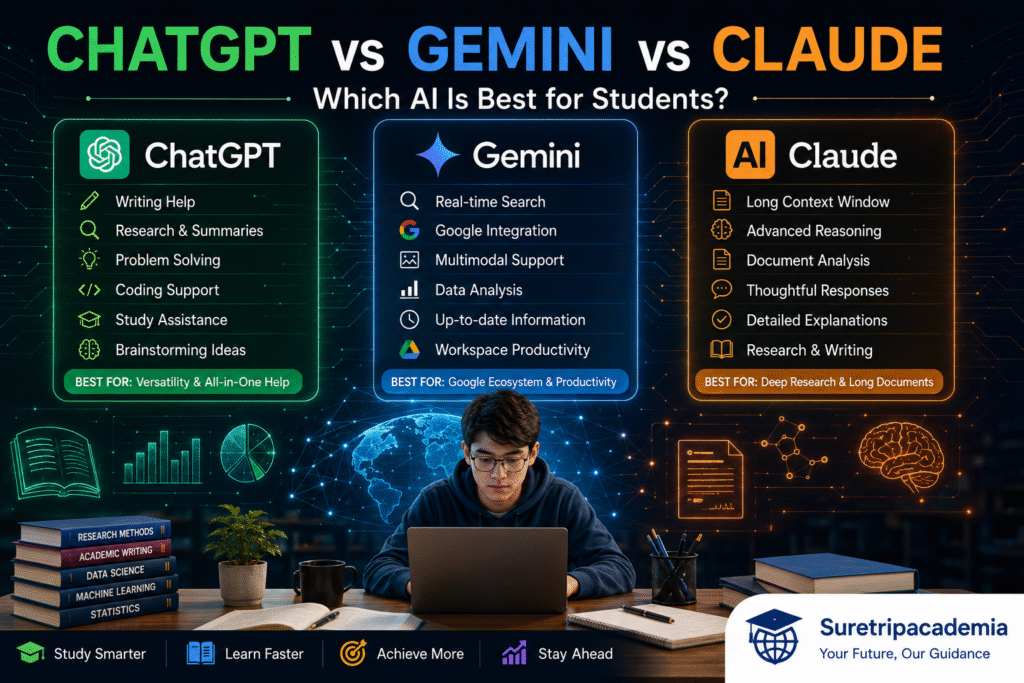
FAQs
Is ChatGPT better than Gemini for students?
For most academic tasks, ChatGPT generally provides stronger tutoring, writing assistance, and coding support.
Is Claude better than ChatGPT?
Claude excels at processing large documents and research-heavy projects, but ChatGPT offers broader versatility.
Can AI help students get scholarships?
Yes. AI can assist with brainstorming, editing, and structuring scholarship applications, though students should ensure the final submission reflects their authentic voice.
Which AI is best for thesis writing?
Claude is particularly effective for large research projects and long-form academic documents.
Should students rely completely on AI?
No. AI should be used as a learning aid, not as a replacement for independent thinking and academic integrity.
Final Thought
AI tools are transforming education, but the most successful students are not necessarily those with access to the best AI. They are the students who know how to ask better questions.
Mastering prompt writing may become one of the most valuable academic and professional skills of the AI era.
AI is most powerful when used as a learning partner rather than a shortcut. Students who learn how to ask better questions, evaluate information critically, and apply AI responsibly will gain a significant academic and professional advantage in the years ahead.
Author Bio
SureTripAcademia Editorial Team
SureTripAcademia empowers students worldwide with trusted resources on scholarships, study abroad opportunities, career development, educational technology, and academic success.