
Last Updated: June 2026
To ensure accuracy and relevance, this article has been carefully reviewed and updated with the latest information on affordable universities in Europe, international student admissions, tuition fees, scholarship programs, living expenses, post-study opportunities, and higher education trends for the 2026/2027 academic year.

Top Universities in Europe with Low Tuition Fees
For millions of students around the world, studying abroad is a life-changing dream. However, the rising cost of higher education in countries such as the United States, Canada, Australia, and the United Kingdom often places that dream beyond the reach of many talented students. The good news is that obtaining a world-class degree does not always require paying exorbitant tuition fees.
Europe has emerged as one of the most attractive destinations for international students seeking high-quality education at an affordable cost. Home to some of the world’s oldest, most prestigious, and globally recognized universities, Europe offers an exceptional combination of academic excellence, cultural diversity, research opportunities, and career prospects. Even more appealing, several European countries provide low-cost or tuition-free education through their public university systems, making higher education accessible to students from all backgrounds.
From Germany’s renowned public universities and Austria’s affordable degree programs to Poland’s budget-friendly institutions and France’s prestigious yet reasonably priced universities, Europe offers numerous pathways to academic success without the burden of overwhelming student debt. Many universities also provide scholarships, grants, and financial aid programs that further reduce the cost of studying abroad.
In this comprehensive guide, we explore the top universities in Europe with low tuition fees, compare tuition costs and living expenses across different countries, examine scholarship opportunities, discuss admission requirements, and highlight the best destinations for international students seeking both affordability and academic excellence. Whether you are planning to pursue a bachelor’s degree, master’s degree, or doctoral studies, this guide will help you make informed decisions and identify the European universities that offer the greatest value for your educational investment.
By the end of this article, you will have a clear understanding of where to study, how much it will cost, what scholarships are available, and which European countries provide the best opportunities for your academic and professional future.
Table of Contents
- Why Study in Europe?
- Benefits of Affordable European Universities
- How Much Does It Cost to Study in Europe?
- Countries with the Lowest Tuition Fees
- Cheapest Student Cities in Europe
- Factors to Consider Before Choosing a University
- Top Universities in Germany
- Top Universities in Norway
- Top Universities in Finland
- Top Universities in Austria
- Top Universities in France
- Top Universities in Poland
- Top Universities in Hungary
- Top Universities in Czech Republic
- Top Universities in Portugal
- Top Universities in Spain
- Top Universities in Italy
- Top Universities in Belgium
- Tuition Fee Comparison Table
- Cost of Living Comparison
- Scholarship Opportunities
- Best Universities for Business Students
- Best Universities for Engineering Students
- Best Universities for Medical Students
- Best Universities for Computer Science Students
- Admission Requirements
- Student Visa Requirements
- Part-Time Work Opportunities
- Return on Investment (ROI)
- Best Countries for Post-Study Employment
- Common Mistakes Students Make
- How to Apply Successfully
- Official Application & Admissions Links
- Country-by-Country Scholarship Table
- Admission Requirements by Country
- Frequently Asked Questions
- Final Recommendations
- Sources and References
- Author Bio
- Final Call to Action (CTA)
Why Study in Europe?

Europe hosts many of the world’s oldest and most respected universities.
Students benefit from:
- Globally recognized qualifications
- Affordable tuition fees
- Multicultural environments
- Strong research opportunities
- Excellent quality of life
- Access to the European job market
- Extensive scholarship programs
For many students, Europe offers the perfect balance between affordability and academic excellence.
Benefits of Affordable European Universities
Choosing an affordable university in Europe is not simply about reducing educational expenses—it is about maximizing value, expanding global opportunities, and obtaining a world-class education without accumulating excessive debt.
European universities consistently rank among the world’s best institutions while offering significantly lower tuition fees compared to many destinations such as the United States, Canada, Australia, and the United Kingdom.
1. Lower Financial Burden
One of the biggest advantages of studying in Europe is the opportunity to obtain a high-quality degree at a fraction of the cost charged by universities in other developed countries.
Students can often graduate with little or no student debt, allowing them greater financial freedom after graduation.
2. Globally Recognized Degrees
European universities are respected worldwide and produce graduates who are highly sought after by employers, research institutions, and multinational organizations.
Degrees obtained from reputable European institutions are recognized across Europe, North America, Asia, Africa, and the Middle East.
3. Access to Scholarships
Many European governments, universities, and organizations provide scholarships specifically designed for international students.
These scholarships can significantly reduce or completely eliminate educational expenses.
4. High Academic Standards
Europe is home to some of the oldest and most prestigious universities in the world, known for academic excellence, innovation, and research leadership.
Students benefit from experienced faculty members, modern facilities, and cutting-edge research opportunities.
5. Diverse Cultural Experience
Studying in Europe allows students to experience different cultures, languages, and perspectives while building an international network of friends and professional contacts.
6. Post-Graduation Employment Opportunities
Many European countries offer pathways for graduates to remain and seek employment after completing their studies.
This creates opportunities for international students to launch successful careers within Europe.
How Much Does It Cost to Study in Europe?
The cost of studying in Europe varies depending on the country, university, program, and lifestyle choices.
However, Europe generally remains one of the most affordable destinations for higher education.
Average Tuition Fees by Country
| Country | Annual Tuition Range |
|---|---|
| Germany | €0 – €3,000 |
| Austria | €700 – €1,500 |
| France | €170 – €3,500 |
| Italy | €900 – €4,000 |
| Portugal | €1,500 – €4,500 |
| Spain | €1,000 – €4,500 |
| Poland | €2,000 – €6,000 |
| Hungary | €2,000 – €8,000 |
| Belgium | €900 – €5,000 |
| Czech Republic | €0 – €5,000 |
Estimated Monthly Living Expenses
| Country | Monthly Cost |
|---|---|
| Poland | €500 – €900 |
| Hungary | €500 – €900 |
| Portugal | €700 – €1,000 |
| Spain | €800 – €1,200 |
| Germany | €850 – €1,200 |
| Austria | €900 – €1,400 |
| France | €900 – €1,500 |
| Belgium | €900 – €1,400 |
Total Annual Budget Estimate
Most international students can realistically budget between €8,000 and €20,000 per year, depending on their chosen destination and lifestyl
Countries with the Lowest Tuition Fees
Several European countries consistently rank among the most affordable study destinations.
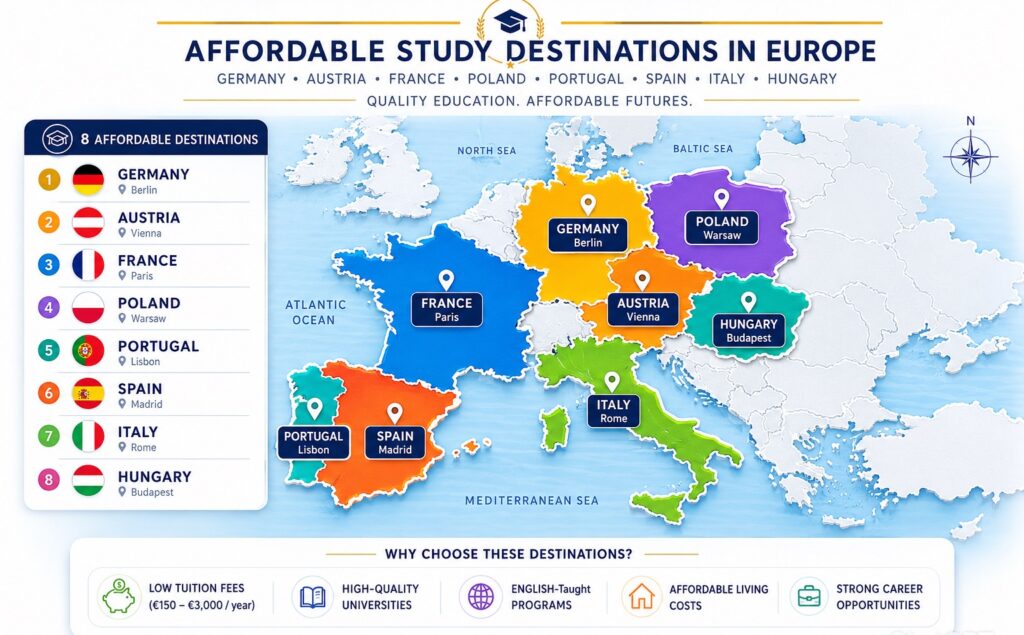
| Country | Typical Annual Tuition |
|---|---|
| Germany | €0 – €3,000 |
| Norway | €0 – €5,000 |
| Austria | €700 – €1,500 |
| France | €170 – €3,500 |
| Poland | €2,000 – €6,000 |
| Hungary | €2,000 – €8,000 |
| Portugal | €1,500 – €4,500 |
| Italy | €900 – €4,000 |
| Spain | €1,000 – €4,500 |
Cheapest Student Cities in Europe
| City | Country | Average Monthly Cost |
|---|---|---|
| Krakow | Poland | €500–€800 |
| Budapest | Hungary | €500–€900 |
| Brno | Czech Republic | €550–€900 |
| Porto | Portugal | €700–€1,000 |
| Valencia | Spain | €800–€1,100 |
Factors to Consider Before Choosing a University
Selecting a university should involve more than simply comparing tuition fees.
Students should carefully evaluate several important factors before making a final decision.
Academic Reputation
Consider the university’s rankings, accreditation, faculty expertise, and reputation within your field of study.
Program Quality
Review course content, specialization options, practical training opportunities, and graduate outcomes.
Scholarship Availability
Research scholarships offered by the university, government agencies, and international organizations.
Cost of Living
A university with low tuition may be located in a city with high living expenses.
Consider housing, transportation, food, and healthcare costs.
Language of Instruction
Verify whether your program is taught in English or requires proficiency in another language.
Career Opportunities
Investigate internship programs, industry partnerships, and graduate employment rates.
Post-Study Work Rights
Countries offering post-graduation work permits can provide valuable career opportunities.
Top Universities in Germany

Germany remains one of the most affordable destinations for higher education.
Recommended Universities
Technical University of Munich (TUM)
Why Choose TUM?
- World-class engineering programs
- Strong research reputation
- Excellent employment outcomes
- Extensive industry partnerships
Ludwig Maximilian University of Munich
Highlights:
- Strong business and social sciences
- Research-intensive environment
- International recognition
Heidelberg University
Highlights:
- Germany’s oldest university
- Outstanding medical programs
- Excellent research facilities
Average Tuition:
€0–€3,000 annually
Top Universities in Norway
Norway offers exceptional education quality and stunning living conditions.
Recommended Universities
University of Oslo
Known for:
- Research excellence
- International student support
- Diverse academic programs
Norwegian University of Science and Technology (NTNU)
Known for:
- Engineering
- Technology
- Innovation
Average Tuition:
Public universities traditionally offered tuition-free education, though policies may vary depending on student nationality and program.
Top Universities in Finland
Finland consistently ranks among the world’s best education systems.
Recommended Universities
University of Helsinki
Strengths:
- Research excellence
- Life sciences
- International programs
Aalto University
Strengths:
- Business
- Technology
- Design
Top Universities in Austria
Austria combines affordability with excellent quality of life.
Recommended Universities
University of Vienna
Highlights:
- Strong humanities
- International reputation
- Affordable tuition
Vienna University of Technology
Highlights:
- Engineering
- Computer Science
- Applied sciences
Top Universities in France
France offers prestigious institutions at relatively low tuition costs.

Recommended Universities
Sorbonne University
Strengths:
- Humanities
- Science
- Research
Université Paris-Saclay
Strengths:
- STEM programs
- Research excellence
- Innovation ecosystem
Top Universities in Poland
Poland has become increasingly popular among international students.
Recommended Universities
University of Warsaw
Jagiellonian University
Warsaw University of Technology
Advantages:
- Affordable tuition
- Low living costs
- Growing economy

Top Universities in Hungary
Hungary offers affordable education and generous scholarship opportunities.
Eötvös Loránd University (ELTE)
Highlights
- One of Hungary’s most prestigious institutions
- Strong international student community
- Wide range of English programs
University of Szeged
Highlights
- Popular among medical students
- Modern facilities
- Research-focused environment
Top Universities in Czech Republic
Charles University
Highlights
- Founded in 1348
- Highly respected globally
- Strong medical and science faculties
Czech Technical University in Prague
Highlights
- Engineering excellence
- Strong industry partnerships
- Modern technological infrastructure
Top Universities in Portugal
University of Lisbon
Highlights
- Portugal’s largest university
- Diverse academic offerings
- Strong international reputation
University of Porto
Highlights
- Research-intensive institution
- Excellent engineering and business programs
Top Universities in Spain
University of Barcelona
Highlights
- Globally recognized
- Strong research output
- International student-friendly
Autonomous University of Barcelona
Highlights
- Excellent academic reputation
- Strong social sciences and STEM programs
Top Universities in Italy
University of Bologna
Highlights
- Oldest university in the Western world
- Outstanding academic tradition
- Wide range of programs
Sapienza University of Rome
Highlights
- One of Europe’s largest universities
- Strong engineering and medicine faculties
Top Universities in Belgium
KU Leuven
Highlights
- Consistently ranked among Europe’s best universities
- Strong research environment
- Excellent graduate employability
Ghent University
Highlights
- Research-intensive institution
- Strong life sciences and engineering programs
Tuition Fee Comparison Table
| University | Country | Estimated Annual Tuition |
|---|---|---|
| TUM | Germany | €0–€3,000 |
| Heidelberg University | Germany | €0–€3,000 |
| University of Oslo | Norway | €0–€5,000 |
| University of Helsinki | Finland | €0–€13,000 |
| University of Vienna | Austria | €700–€1,500 |
| Sorbonne University | France | €170–€3,500 |
| University of Warsaw | Poland | €2,000–€6,000 |
| University of Bologna | Italy | €900–€4,000 |
Cost of Living Comparison
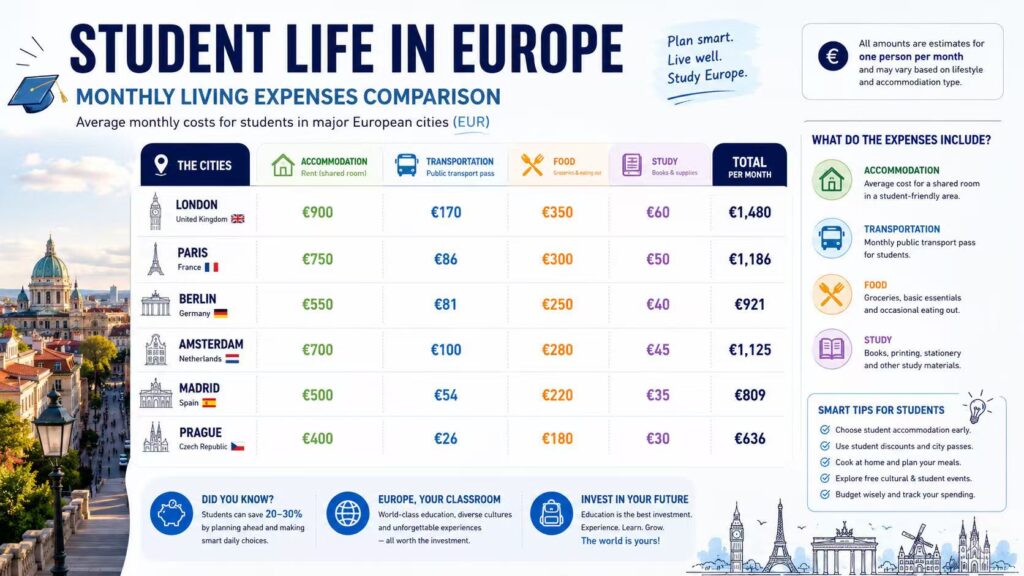
Tuition is only part of the equation.
Students should also consider living expenses.
| Country | Average Monthly Living Cost |
|---|---|
| Germany | €850–€1,200 |
| Poland | €500–€900 |
| Hungary | €500–€900 |
| Portugal | €700–€1,200 |
| Spain | €800–€1,300 |
| France | €900–€1,500 |
| Austria | €900–€1,400 |
| Norway | €1,200–€2,000 |
Scholarship Opportunities
Many European governments and universities provide generous scholarship programs.
Popular Scholarships
Erasmus+
One of the most prestigious scholarship programs in Europe.
Benefits may include:
- Tuition support
- Travel grants
- Monthly stipends
DAAD Scholarships (Germany)
Highly competitive scholarships supporting international students.
Stipendium Hungaricum
Provides:
- Full tuition coverage
- Accommodation support
- Monthly stipend
Italian Government Scholarships
Available for international students pursuing undergraduate and postgraduate studies.
Best Universities for Business Students
Recommended Institutions:
- University of Mannheim (Germany)
- Erasmus University Rotterdam (Netherlands)
- Vienna University of Economics and Business (Austria)
- Bocconi University (Italy)
- Aalto University (Finland)
Best Universities for Engineering Students
Recommended Institutions:
- Technical University of Munich
- ETH Zurich
- Delft University of Technology
- Vienna University of Technology
- NTNU
Best Universities for Medical Students
Europe offers some of the world’s most respected medical schools at comparatively affordable tuition rates.
| University | Country |
|---|---|
| Heidelberg University | Germany |
| Charles University | Czech Republic |
| University of Szeged | Hungary |
| Sapienza University of Rome | Italy |
| Jagiellonian University | Poland |
| University of Bologna | Italy |
| KU Leuven | Belgium |
| Sorbonne University | France |
Why Study Medicine in Europe?
- Internationally recognized degrees
- Modern teaching hospitals
- Lower tuition fees than many Western countries
- Strong clinical training opportunities
Best Universities for Computer Science Students
Recommended Institutions:
- Technical University of Munich
- Aalto University
- University of Helsinki
- Delft University of Technology
- ETH Zurich

Admission Requirements
Requirements vary by university and program, but most institutions require the following.
Bachelor’s Programs
Academic Requirements
- Secondary school certificate
- Official transcripts
- Passport
Language Requirements
- IELTS
- TOEFL
- Cambridge English qualifications
Supporting Documents
- Motivation letter
- Recommendation letters (sometimes required)
Master’s Programs
Academic Requirements
- Relevant bachelor’s degree
- Academic transcripts
Additional Requirements
- Curriculum Vitae (CV)
- Statement of Purpose
- Recommendation letters
Student Visa Requirements
Most European countries require international students to obtain a student visa or residence permit.
Common Requirements
Valid Passport
Passport validity must typically extend beyond the intended study period.
Admission Letter
Official acceptance letter from a recognized institution.
Financial Proof
Evidence showing sufficient funds to support living expenses.
Health Insurance
Valid health insurance coverage.
Accommodation Evidence
Proof of housing arrangements.
Visa Application Form
Completed and signed application documents.

Part-Time Work Opportunities
Many European countries permit international students to work while studying.
Benefits of Student Employment
- Additional income
- Professional experience
- Improved language skills
- Networking opportunities
Typical Student Jobs
- University assistant
- Tutor
- Customer service representative
- Hospitality staff
- Research assistant
- Administrative assistant
Average Student Earnings
| Country | Estimated Hourly Wage |
|---|---|
| Germany | €12–€15 |
| France | €11–€14 |
| Belgium | €12–€16 |
| Austria | €11–€15 |
| Portugal | €7–€10 |
| Poland | €6–€10 |

Return on Investment (ROI)
Affordable tuition significantly improves educational ROI.
Students can often graduate with:
- Lower debt
- Stronger financial flexibility
- Better long-term career opportunities
Countries such as Germany, Austria, and Poland frequently provide excellent returns on educational investment.
Best Countries for Post-Study Employment
Students should consider employment opportunities when selecting a study destination.
Germany
Advantages
- Strong economy
- High demand for skilled professionals
- Attractive post-study work opportunities
Netherlands
Advantages
- International business environment
- English-speaking workplaces
- Competitive salaries
France
Advantages
- Diverse economy
- Opportunities in technology, engineering, and business
Belgium
Advantages
- Headquarters of major international organizations
- Strong logistics and finance sectors
Austria
Advantages
- High quality of life
- Growing technology sector
- Excellent work-life balance
Portugal
Advantages
- Expanding startup ecosystem
- Growing technology industry
- Increasing demand for skilled graduates
Recommendation
For students seeking the best combination of affordability, educational quality, scholarship opportunities, and post-graduation career prospects, Germany, France, Austria, Poland, Italy, and Portugal remain among the strongest choices in Europe. By carefully comparing tuition fees, living costs, admission requirements, scholarships, and employment prospects, students can make informed decisions that maximize both educational and career outcomes.
Common Mistakes Students Make
Avoid these common errors:
- Focusing only on tuition costs
- Ignoring living expenses
- Missing scholarship deadlines
- Applying too late
- Overlooking visa requirements
- Choosing programs without considering career outcomes

How to Apply Successfully
Step 1: Research Programs
Identify universities aligned with your academic and career goals.
Step 2: Verify Admission Requirements
Review:
- Academic transcripts
- Language proficiency requirements
- Application deadlines
Step 3: Prepare Financial Documentation
Many visa applications require proof of sufficient funds.
Step 4: Apply for Scholarships
Apply as early as possible.
Step 5: Submit Strong Application Materials
Focus on:
- Personal statements
- Recommendation letters
- Academic achievements
Official Application & Admissions Links
| University | Country | Official Admissions Page |
|---|---|---|
| Technical University of Munich (TUM) | Germany | TUM Admissions |
| Ludwig Maximilian University of Munich (LMU) | Germany | LMU International Admissions |
| Heidelberg University | Germany | Heidelberg University Admissions |
| University of Oslo | Norway | University of Oslo Admissions |
| Norwegian University of Science and Technology (NTNU) | Norway | NTNU Admissions |
| University of Helsinki | Finland | University of Helsinki Admissions |
| Aalto University | Finland | Aalto University Admissions |
| University of Vienna | Austria | University of Vienna Admissions |
| Vienna University of Technology | Austria | TU Wien Admissions |
| Sorbonne University | France | Sorbonne Admissions |
| Université Paris-Saclay | France | Paris-Saclay Admissions |
| University of Warsaw | Poland | University of Warsaw Admissions |
| Jagiellonian University | Poland | Jagiellonian Admissions |
| Warsaw University of Technology | Poland | Warsaw Tech Admissions |
| University of Bologna | Italy | University of Bologna Admissions |
| Sapienza University of Rome | Italy | Sapienza Admissions |
| University of Lisbon | Portugal | University of Lisbon Admissions |
| University of Barcelona | Spain | University of Barcelona Admissions |

Country-by-Country Scholarship Table
| Country | Major Scholarship Programs | Coverage |
|---|---|---|
| Germany | DAAD Scholarships | Full/Partial Tuition + Living Stipend |
| France | Eiffel Excellence Scholarship | Tuition + Living Expenses |
| Italy | Italian Government Scholarships | Tuition + Monthly Allowance |
| Hungary | Stipendium Hungaricum | Fully Funded |
| Finland | Finland Scholarship | Tuition + Relocation Grants |
| Austria | OeAD Scholarships | Tuition + Living Support |
| Norway | University-specific grants | Partial Funding |
| Poland | NAWA Scholarships | Tuition + Stipend |
| Portugal | University Merit Scholarships | Partial Funding |
| Spain | MAEC-AECID Scholarships | Tuition + Living Costs |
Admission Requirements by Country
Germany
Bachelor’s
- High school certificate equivalent to German Abitur
- English or German proficiency
- Passport
- Academic transcripts
Master’s
- Relevant bachelor’s degree
- GPA requirements vary
- IELTS/TOEFL where applicable
- Motivation letter
Norway
Bachelor’s
- Secondary education qualification
- Language requirements
- Financial proof
Master’s
- Relevant bachelor’s degree
- English proficiency documentation
- Academic transcripts
- Passport documentation
NTNU generally requires a relevant bachelor’s degree, English proficiency, and strong academic performance for master’s admission.
Finland
Bachelor’s
- Secondary school certificate
- Entrance examination (some programs)
- Language proficiency
Master’s
- Bachelor’s degree
- Statement of purpose
- Academic transcripts
- English proficiency
France
Bachelor’s
- Secondary education qualification
- Language proficiency
- Campus France procedures (many countries)
Master’s
- Relevant undergraduate degree
- CV
- Motivation letter
- Academic records
Italy
Bachelor’s
- High school diploma
- Language requirements
- Pre-enrollment procedures
Master’s
- Relevant degree
- Academic transcripts
- Statement of purpose
- Language requirements

Frequently Asked Questions
Which European country offers free university education?
Germany remains one of the most affordable destinations, with many public universities charging minimal or no tuition fees for certain students and programs.
Which country has the lowest living costs?
Poland and Hungary are often among the most affordable options.
Can international students work while studying?
Most European countries permit part-time work under specific visa regulations.
Are European degrees recognized internationally?
Yes. Degrees from accredited European universities are widely recognized globally.
Which country is best for international students?
Germany, France, the Netherlands, Austria, and Finland consistently rank among the most popular choices.
Final Recommendations
Europe continues to provide exceptional opportunities for students seeking affordable, high-quality education.
For students prioritizing low tuition fees and strong career prospects, Germany, Austria, Poland, Portugal, and France remain among the best options.
By combining affordable tuition, scholarships, careful financial planning, and strategic university selection, students can obtain a world-class education while minimizing financial burden.
The key is to start planning early, apply strategically, and explore every scholarship opportunity available.
Sources and References
The information presented in this article is compiled from publicly available resources, including official university websites, government education agencies, scholarship providers, international student organizations, and higher education institutions across Europe.
While every effort has been made to ensure accuracy at the time of publication, tuition fees, admission requirements, scholarship opportunities, visa regulations, and living costs may change over time. Prospective students are strongly encouraged to verify the latest information directly through the official websites of their chosen universities, scholarship providers, and relevant government authorities before making application or enrollment decisions.
This guide is intended for informational purposes and should be used as a starting point for researching study opportunities in Europe.
Author Bio
SureTripAcademia Editorial Team
SureTripAcademia helps students worldwide discover scholarships, affordable universities, study abroad and Job opportunities, career pathways, and educational resources that support academic and professional success.
For inquiries:
- Website: SureTripAcademia
- Email: admin@suretripacademia.com
- WhatsApp: +8615008083706
- Facebook: SureTripAcademia
- TikTok: SureTripAcademia
Final Call to Action
Are you planning to study in Europe?
Start by identifying your preferred country, researching scholarship opportunities, and preparing your application documents early. The sooner you begin, the greater your chances of securing admission and financial support at one of Europe’s top affordable universities.