
By: Michael | Last Updated: July 3, 2026 | Reading Time: 6 minutes
Transparency Note: Verified for the 2026/2027 academic planning cycle. Contains independent data points from the National Association of Colleges and Employers (NACE), Gallup Polls, and the World Economic Forum (WEF).
If you are currently sitting in a university lecture hall, writing tuition checks, or staring at a pile of college applications, a quiet sense of anxiety has likely crossed your mind. You aren’t alone. A comprehensive Gallup poll revealed that 42% of bachelor’s degree students have seriously reconsidered their choice of major due to the rapid evolution of generative artificial intelligence, and 16% have already switched paths entirely.
The old agreement ‘spend four years, collect a diploma, secure a stable corporate career‘ is breaking down. With advanced AI systems writing production-grade code, financial models, and marketing copy in seconds, a foundational question emerges: Is a college degree still worth the investment, or is AI turning that expensive piece of parchment into a relic?
The short answer is: The traditional “information-retrieval” degree is dying, but the strategic, network-driven degree has never been more valuable.
Here is exactly how the landscape has shifted for the 2026/2027 academic years, and what you must do to remain indispensable to employers.
The 2026/2027 Higher Education Matrix
To understand where your major stands, we must map out how the market evaluates academic credentials versus practical capability.
| Career Dimension | The Old Degree Era | The AI-Driven Era (2026/2027) |
| Primary Hiring Filter | Institutional prestige and GPA. | Demonstrated technical competency and project portfolios. |
| Curriculum Lifespan | 5 to 10 years before structural updates. | Less than 18 months before core concepts require upskilling. |
| Corporate Standard | Degree required as an absolute barrier to entry. | Skills-First Hiring (Google, IBM, Bank of America have removed degree mandates). |
| Core Value of College | Access to textbook information and lectures. | Access to deep human networks, research labs, and peer ambition. |
Why the “Pedigree Filter” Has Shattered
For decades, human resource departments used a four-year bachelor’s degree as a simple screening tool to filter out candidates. Today, that filter is actively failing.
According to the NACE Job Outlook survey, 70% of employers now use skills-based hiring for entry-level roles, vetting applicants on what they can actually execute rather than where they went to school.
The Changing Face of the Modern Classroom
Universities are rapidly redesigning their campus infrastructure. The passive, 300-person lecture hall where students simply copy slides is giving way to tech-integrated, active-learning environments.
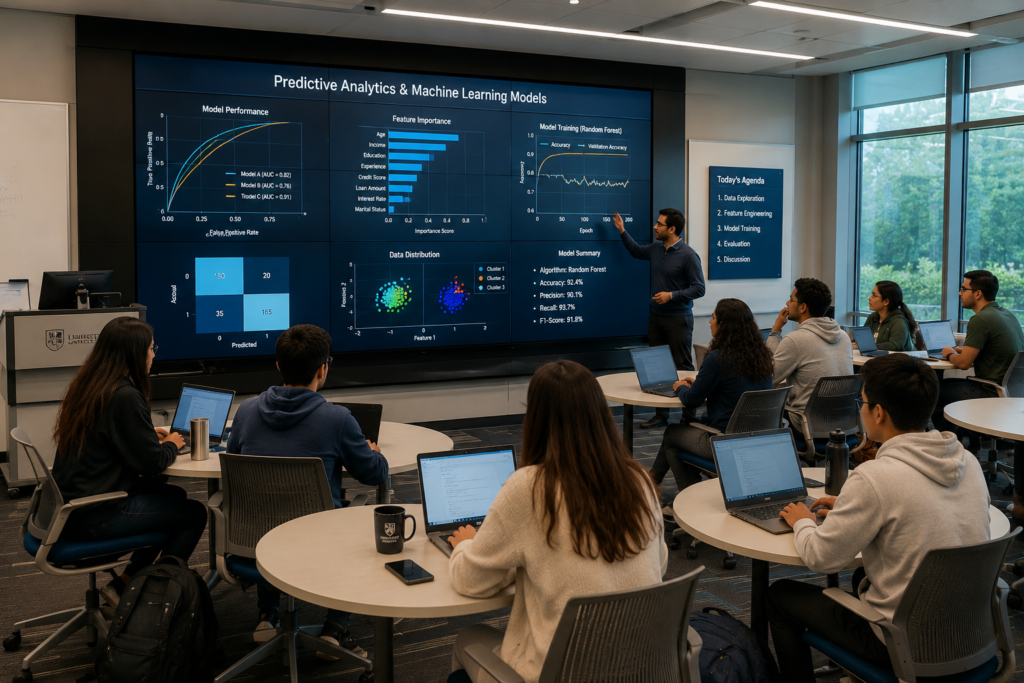
As shown above, the actual value of a 2026 university campus isn’t the lecture itself which could easily be summarized by an advanced language model but the physical environment where you learn to navigate complex, multi-person dynamics and high-end technological toolkits.
The Hard Truth: If a machine can pass your final exam with an A grade based purely on text outputs, then your future employer will use that machine instead of hiring a graduate who only knows how to do the same thing.
Test Your Major: The AI-Era Degree Value Estimator
To find out exactly how vulnerable your current or planned academic track is, use this interactive evaluation tool. Adjust the parameters based on your field of study, your personal comfort with AI workflows, and the practical work you’ve completed outside of class.
How to Audit Your College Curriculum in 4 Steps
If you choose to pursue or continue a university degree, you cannot afford to take a passive approach. You must actively audit your classes to ensure they are providing real, non-automatable value. Follow this exact workflow every semester:
Step 1: Assess the Assessment Styles: Week 1 of Semester.
Look closely at your syllabus. Are you being graded on essay memorization, multiple-choice questions, or basic code syntax? Globally, 72% of students note that their college tests do not reflect the judgment needed in an AI-driven workplace. If a course relies purely on rote recall, immediately supplement it with outside projects.
Step 2: Identify the ‘Human-Centric Moat: Ongoing Analysis.
Pinpoint elements of the course that a machine cannot simulate. Focus your energy heavily on team dynamics, high-stakes live presentations, conflict resolution, and nuanced ethical debate. These form your “human moat.”
Step 3: Build a Dual-Track Portfolio: Mid-Term Benchmark.
For every major theoretical framework you learn in class, build a practical, real-world application. If you are learning macroeconomics, don’t just write a term paper; build a data scraping pipeline or a financial dashboard tracking real-time regional indicators.
Step 4: Secure the Institutional Network: Before Final Exams.
Leverage your student status to access things money cannot buy later: direct research assistantships under leading professors, exclusive campus incubator funds, and close alumni mentorship pipelines. The network is your ultimate return on investment (ROI).
Frequently Asked Questions
Should I drop out of college if my field is highly exposed to AI?
Absolutely not for the vast majority of students. Instead of dropping out, pivot your focus. The value of a degree is shifting from what you know to how you orchestrate tools and work with people. A university degree provides a structured playground to build advanced collaborative skills that are incredibly difficult to replicate in isolation.
What fields are showing the highest resilience against automation in 2026/2027?
Fields that involve deep physical interaction, highly specialized spatial reasoning, complex human empathy, or high-stakes accountability remain incredibly resilient. Think human healthcare, advanced surgical nursing, complex structural engineering, environmental field research, and strategic organizational management.
How do I prove my value to a company that uses AI hiring screeners?
Show, don’t tell. Do not just list your degree and GPA on your resume. Instead, feature clean links to public code repositories, live web applications, documented case studies, or video walkthroughs of complex problems you have solved. When recruiters screen for skills, your portfolio functions as your real currency.
Related Guides You May Find Helpful
- Study in Iceland for Free
- Best Scholarships in Canada for International Students
- Chevening Scholarship Application Guide
- DAAD Scholarship Complete Application Guide
- New Zealand Government Scholarship Application Guide
- MEXT Scholarship Application
- Australia Awards Scholarship Guide
- Undergraduate Scholarships in Canada
Michael – Editor at SureTripAcademia, your dedicated resource for unlocking global mobility and international educational opportunities. WhatsApp l Facebook l TikTok
DISCLAIMER:
This article is an independent editorial analysis intended purely for educational and informational purposes. While we make every effort to ensure the labor statistics, corporate hiring trends, and academic metrics are accurate for the 2026/2027 cycle, the tech sector and global employment markets shift incredibly fast. The insights shared here should not be taken as formal career counseling or financial advice. We highly recommend cross-referencing specific degree requirements and job placement data directly with individual university admissions offices before making any major enrollment or financial commitments.